Enterprise AI
Reference Architecture
This document serves as a dynamic architectural artifact for designing and constructing enterprise-grade agentic AI systems. It integrates deterministic workflows with probabilistic reasoning while addressing real operational constraints.
Why This Architecture Exists
Most enterprise AI architectures fail because they focus on models instead of systems.
Production AI requires:
- Context
- Orchestration
- Evaluation
- Governance
- Human approval
- Observability
This architecture describes how these capabilities fit together.
What Makes This Architecture Different
- Treats evaluation as a runtime capability, not an afterthought
- Separates deterministic and probabilistic workloads
- Includes human approval as a first-class architectural component
- Models AI as a production system rather than a chatbot
Executive Summary
Enterprise AI systems extend beyond isolated language model calls. They are context-driven architectures that integrate workflows, retrieval mechanisms, memory, and model behavior within real operational constraints.
This reference architecture offers a comprehensive framework for designing agentic AI systems capable of reliable operation in enterprise environments, where governance, observability, cost control, and human oversight are essential requirements.
The architecture delineates deterministic workflows from probabilistic reasoning, allowing organizations to retain control while utilizing the flexibility of large language models.
Problem Classes for Runtime AI
Not all problems benefit from AI. Before choosing an architecture, architects should first classify the problem being solved. Four classes of problems consistently benefit from AI-powered runtimes.
Four Classes of AI Problems
Generative Problems
Create new content from existing context.
Examples
- Code generation
- Report generation
- Summarization
- Content creation
Reasoning Problems
Synthesize, compare, evaluate, or explain information.
Examples
- Root cause analysis
- Policy interpretation
- Contract review
- Supply chain recommendations
Extraction & Transformation Problems
Convert unstructured information into structured outputs.
Examples
- Invoice extraction
- Document classification
- Translation
- Legacy-to-modern format conversion
Agentic Execution Problems
Plan and execute actions across systems.
Examples
- Travel booking
- Procurement workflows
- Customer support orchestration
- Multi-system automation
Identifying an AI-friendly problem class does not automatically mean AI should be used. The next question is whether the problem characteristics justify a runtime AI architecture.
Decision Matrix: Which Problems Are AI Problems?
| Problem Characteristic | Traditional Software | AI Runtime |
|---|---|---|
| Rules are stable and explicit | ✓ | |
| Outcome must be deterministic | ✓ | |
| Requires judgment | ✓ | |
| Inputs are highly variable | ✓ | |
| Knowledge changes frequently | ✓ | |
| Requires interpretation | ✓ | |
| Regulatory precision required | ✓ | |
| Natural language is primary interface | ✓ |
Use Traditional Software When
- Rules are known
- Outcomes must be exact
- Regulatory risk is high
- Deterministic execution is required
Use AI Runtime When
- Context matters more than rules
- Inputs vary significantly
- Judgment is required
- Human-like reasoning adds value
Use a Hybrid Architecture When
- AI performs reasoning
- Traditional software performs execution
- Human approval controls risk
A Common Mistake
The most common AI architecture mistake is using AI to replace deterministic systems. Enterprise AI works best when AI handles interpretation and reasoning while traditional software handles execution and enforcement.
Architecture Principles
Enterprise AI systems introduce uncertainty, runtime costs, and non-deterministic behavior that traditional software architectures rarely encounter. These principles provide the foundation for designing systems that remain reliable, observable, governable, and economically sustainable in production.
Architecture Foundations
Operational Constraints First
Systems are designed around latency, cost, compliance, reliability, and business risk—not technology trends.
Context as a First-Class Asset
Models provide reasoning. Context provides intelligence. Enterprise AI systems should treat context—including memory, retrieval, policies, and operational state—as a managed architectural capability rather than an implementation detail.
System Design
Deterministic/Probabilistic Separation
Keep reasoning separate from execution. AI should interpret and recommend; deterministic systems should enforce and execute.
Governable Systems
Architect for auditability, policy enforcement, and human oversight from the beginning.
Runtime Operations
Observability by Design
Every decision, tool invocation, retrieval, and model interaction should be traceable.
Graceful Degradation
Systems must continue operating when models fail, time out, or become unavailable.
AI Operations
Evaluation Before Autonomy
Agent autonomy should be earned through measurement. Systems must demonstrate reliability, safety, and predictable behavior before increasing levels of autonomous operation.
Cost-Aware Architecture
Token consumption, model selection, retrieval costs, and orchestration overhead are architectural concerns, not operational afterthoughts.
Architecture Diagram
The accompanying diagram depicts the end-to-end workflow of an enterprise agentic AI system, encompassing actor input, context enrichment, model invocation, and response evaluation.
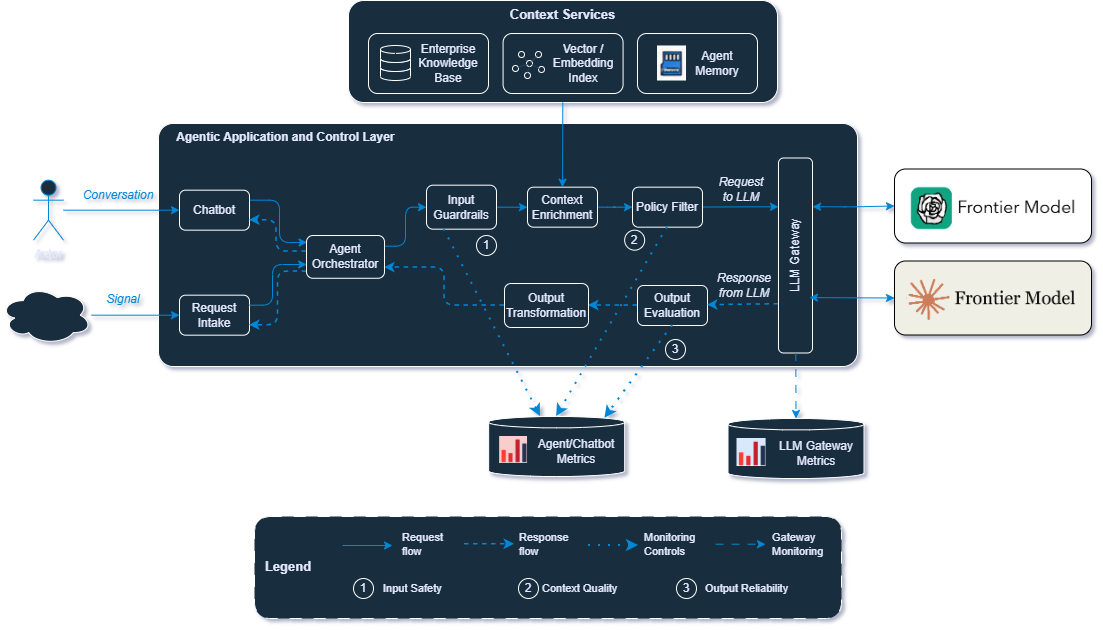
Key Checkpoints
- 1. Input Safety: Validates and sanitizes incoming requests before processing
- 2. Context Quality: Ensures enriched context meets quality thresholds before model invocation
- 3. Output Reliability: Evaluates model responses for accuracy, safety, and policy compliance
Production Control Loop
AI prototypes are typically developed for rapid iteration, which is appropriate for initial validation. However, as a prototype transitions to production, the focus shifts from assessing response utility to ensuring the system can be secured, evaluated, governed, monitored, and trusted within an enterprise workflow.
A prevalent misconception is that linking a chatbot or agent to a model constitutes an agentic AI solution. While incorporating retrieval and memory enhances grounding, these features alone do not ensure production readiness. The system must also implement controls to validate inputs, assess context quality, evaluate outputs, and monitor for drift over time.
The Production Control Loop
What Changes in Production
As the system moves toward production, the architecture must do more than just send prompts to a model. It needs to control the full interaction lifecycle:
- Before a request reaches the model: Check whether the input is safe, well-formed, and allowed
- Before the model generates a response: Ensure that retrieval and enrichment provide relevant and trustworthy context
- Before the response is returned: Evaluate the output for structure, safety, accuracy, policy compliance, and action eligibility
Key Insight: Production agentic AI extends beyond a simple chatbot or event-to-LLM gateway-to-model pipeline. It necessitates a managed control layer to validate inputs, assess context quality, evaluate outputs, monitor system behavior, and establish feedback loops for drift detection and operational alerts.
Runtime Signals for the Control Loop
Improvement is contingent upon measurement. In production AI systems, validation should extend beyond simple pass/fail checks. The system must capture signals such as input rejection frequency, context quality deficiencies, output validation failures, and changes in these patterns over time.
A production-ready agentic system needs runtime signals from three control points:
Input Safety
Before a request reaches the model, the system should validate whether it is safe, well-formed, and allowed. This answers: Are users, upstream systems, or attackers sending risky inputs into the AI system?
Context Quality
Before the model generates a response, the system should measure whether the retrieval and enrichment provided useful grounding. This answers: Did the system provide the model with relevant, current, and trustworthy context?
Output Reliability
Before a response is returned to a user, agent, or downstream system, the system should validate whether it is safe, structured, accurate, and usable. This answers: Is the model producing responses that can be trusted and used safely?
Gateway Metrics (Tracked Separately)
Gateway metrics should be tracked separately because they reflect operational health rather than application-level reasoning quality:
Drift and Alerts
The primary value of these metrics is in detecting trends. While isolated validation failures may be tolerable, significant increases in prompt injection attempts, stale retrieval results, malformed outputs, unsafe recommendations, or human rejections warrant investigation. Such issues may originate from user behavior, upstream data quality, prompt modifications, model upgrades, retrieval adjustments, outdated documents, or changes in business processes.
Operating Principle:
Validate each interaction, measure rejections, monitor trends, and escalate when risk patterns change.
AI Gateway
The AI Gateway is the single point of entry for all model interactions. It provides unified access to multiple model providers while enforcing enterprise policies.
Core Responsibilities
- Model routing and load balancing across providers
- Rate limiting and quota management
- Request/response logging and audit trails
- Cost tracking and budget enforcement
- Fallback and retry logic across providers
- Prompt injection detection and filtering
Design Considerations
The gateway should maintain statelessness and support horizontal scalability. It must accommodate provider-specific authentication, normalize response formats, and manage streaming responses. Implement caching for identical prompts when appropriate.
Agent Orchestration Layer
The orchestration layer manages agent lifecycles, coordinates multi-agent interactions, and enforces workflow constraints. This is where deterministic control meets probabilistic reasoning.
Orchestration Patterns
Sequential Chains
Linear pipelines where output of one agent feeds the next. Predictable but limited flexibility.
Router Patterns
A coordinator agent routes to specialized agents based on intent classification or task type.
Hierarchical Teams
Manager agents delegate to worker agents, aggregating results and making final decisions.
Collaborative Networks
Peer agents share context and negotiate solutions. Most flexible but hardest to govern.
State Management
Agent state should be externalized and persistently stored. In-memory state is suitable only for single-turn interactions, whereas multi-turn conversations, long-running tasks, and recoverable workflows necessitate durable state storage solutions.
Memory Layer
The memory layer provides agents with contextual awareness across interactions. Memory is what transforms stateless model calls into coherent, context-aware systems.
Memory Types
Reasoning Memory
Short-term thinking during task execution: execution plans, intermediate reasoning. Do not store raw traces as long-term memory—store conclusions and validated outcomes.
Working Memory
Temporary information used during a session: current tool outputs, conversation state, active context. Chat sessions are examples.
Episodic Memory
Lasting knowledge from past interactions: user preferences, successful patterns, learned behaviors. Systems like mem0 fit here.
Procedural Memory
Knowledge about how to carry out tasks and workflows: task dependencies, workflow progress, execution patterns.
Implementation Considerations
Memory retrieval should be both rapid and relevant. Employ vector similarity for semantic search, supplemented by metadata filtering to enhance precision. Implement memory decay and consolidation strategies to manage data growth.
Knowledge Layer
The knowledge layer provides agents with access to enterprise information through retrieval-augmented generation (RAG) and structured data access. This is how agents ground their responses in organizational truth.
Knowledge Sources
- Document repositories (policies, procedures, manuals)
- Structured databases (customer records, inventory, transactions)
- Knowledge graphs (entity relationships, taxonomies)
- Real-time data feeds (market data, sensor readings, events)
Retrieval Architecture
Adopt a hybrid retrieval approach that integrates dense vectors for semantic similarity with sparse vectors (BM25) for keyword matching. Utilize re-ranking models to enhance precision, and consistently include source attribution to ensure traceability.
Tool Integration Layer
Tools extend agent capabilities beyond text generation. The tool integration layer manages tool discovery, invocation, authentication, and result handling.
Tool Categories
Read-only Tools
Data retrieval, search, lookups. Low risk, can be invoked freely within rate limits.
Write Tools
Create, update, delete operations. Require validation and often human approval.
Computational Tools
Calculations, transformations, analysis. Deterministic and verifiable.
External APIs
Third-party service integrations. Subject to external rate limits and SLAs.
Tool Governance
Every tool must have a defined schema, permission requirements, and risk classification. Implement tool usage policies that can restrict which agents can invoke which tools under what conditions.
Evaluation Layer
The evaluation layer continuously monitors agent performance, response quality, and overall system health. This process verifies whether the system operates as intended.
Evaluation Dimensions
- Task Success: Did the agent accomplish the stated goal?
- Response Quality: Accuracy, relevance, coherence, safety
- Efficiency: Token usage, latency, cost per interaction
- Safety: Harmful content, policy violations, data leakage
Evaluation Methods
Integrate automated evaluations, such as LLM-as-judge and rule-based checks, with human assessments to achieve nuanced quality evaluation. Develop evaluation datasets that mirror production scenarios, and conduct evaluations following every model or prompt modification.
Observability Layer
Observability in AI systems extends beyond traditional application performance monitoring. It is necessary to trace the reasoning process in addition to the execution path.
Observability Pillars
- Traces: End-to-end request flow including all agent steps, tool calls, and model invocations
- Metrics: Latency distributions, token usage, cost, error rates, tool success rates
- Logs: Structured logs for every decision point, including prompts and completions
- Reasoning Trails: Chain-of-thought captures, decision explanations, confidence scores
Privacy Considerations
Observability data frequently contains sensitive information. Implement mechanisms for personally identifiable information (PII) detection and masking. Establish data retention policies and ensure the security of audit logs.
Human Approval Layer
Not every agent action should be autonomous. The human approval layer defines when and how humans are brought into the loop for oversight, approval, or intervention.
Approval Patterns
Pre-execution Approval
Human must approve before action executes. Highest safety, highest latency.
Post-execution Review
Action executes, human reviews after. Faster but requires undo capability.
Threshold-based
Auto-approve below threshold, require approval above. Balances speed and safety.
Sampling-based
Random sample of actions reviewed. Good for quality monitoring at scale.
Escalation Paths
Establish explicit escalation paths for scenarios involving agent uncertainty or policy violations. Implement timeout mechanisms for pending approvals and provide sufficient context to enable informed human decision-making.
Security & Governance
Enterprise AI systems operate under regulatory, compliance, and security requirements that cannot be compromised for capability or speed.
Security Controls
- Input Validation: Prompt injection detection, input sanitization, content filtering
- Output Validation: PII detection, policy compliance checks, toxicity filtering
- Access Control: Agent-level permissions, tool-level authorization, data access policies
- Data Protection: Encryption at rest and in transit, data residency compliance, retention policies
Governance Framework
- Model inventory and version control
- Prompt management and change control
- Usage policies and acceptable use guidelines
- Incident response procedures for AI-specific failures
- Regular audits and compliance reporting
About This Document
This reference architecture is a dynamic document that evolves as the field advances. It is informed by practical experience in constructing enterprise AI systems across supply chain, retail, and operational domains.
The architecture is implementation-agnostic, specifying required components and their purposes rather than prescribing specific products. Technology selection should be guided by operational constraints, existing infrastructure, and organizational capabilities.
Questions, feedback, or implementation discussions welcome via LinkedIn or advisory engagement.