The LLM Pipeline Problem in AI-SDLC: Error Ossification
Chaining LLMs across the software lifecycle without deterministic gates is an architectural antipattern. Upstream assumptions become downstream axioms, and small ambiguities ossify into production behavior.
I keep coming across the same vision for AI-enabled software delivery.

It sounds efficient: faster delivery, more autonomy, and the promise of true end-to-end AI software engineering. But there is a hidden failure mode in this pattern. The real danger is the lack of strong checkpoints, clear exit criteria, and state validation between stages.
A vague epic becomes a misaligned story. That story produces the wrong task breakdown. The wrong breakdown produces plausible but incorrect code. That code is reviewed against the wrong assumptions. By the time of deployment, the system has not just produced an error. It has accumulated and reinforced it, layer by layer.
This is the AI-SDLC version of error ossification: upstream assumptions become downstream axioms.
At first glance, this resembles the telephone game. Each stage receives a slightly altered version of the original intent and passes it forward. But the AI-SDLC version is more dangerous for one critical reason. Each stage does not merely repeat a message — it produces durable artifacts: stories, tasks, code, tests, reviews, deployment plans, and production changes. Once those artifacts exist, the distorted assumption is no longer a misunderstanding. It becomes a fact embedded in the system, harder to see because it looks authoritative.
The analogy I keep returning to is the exploding gradient — not in the strict mathematical sense but in spirit. Small errors early on get amplified as they move through the chain. In model training, there is a loss signal and a correction mechanism to detect drift. In a pipeline made only of LLMs, there is nothing equivalent. Each stage accepts the previous output as ground truth and proceeds.
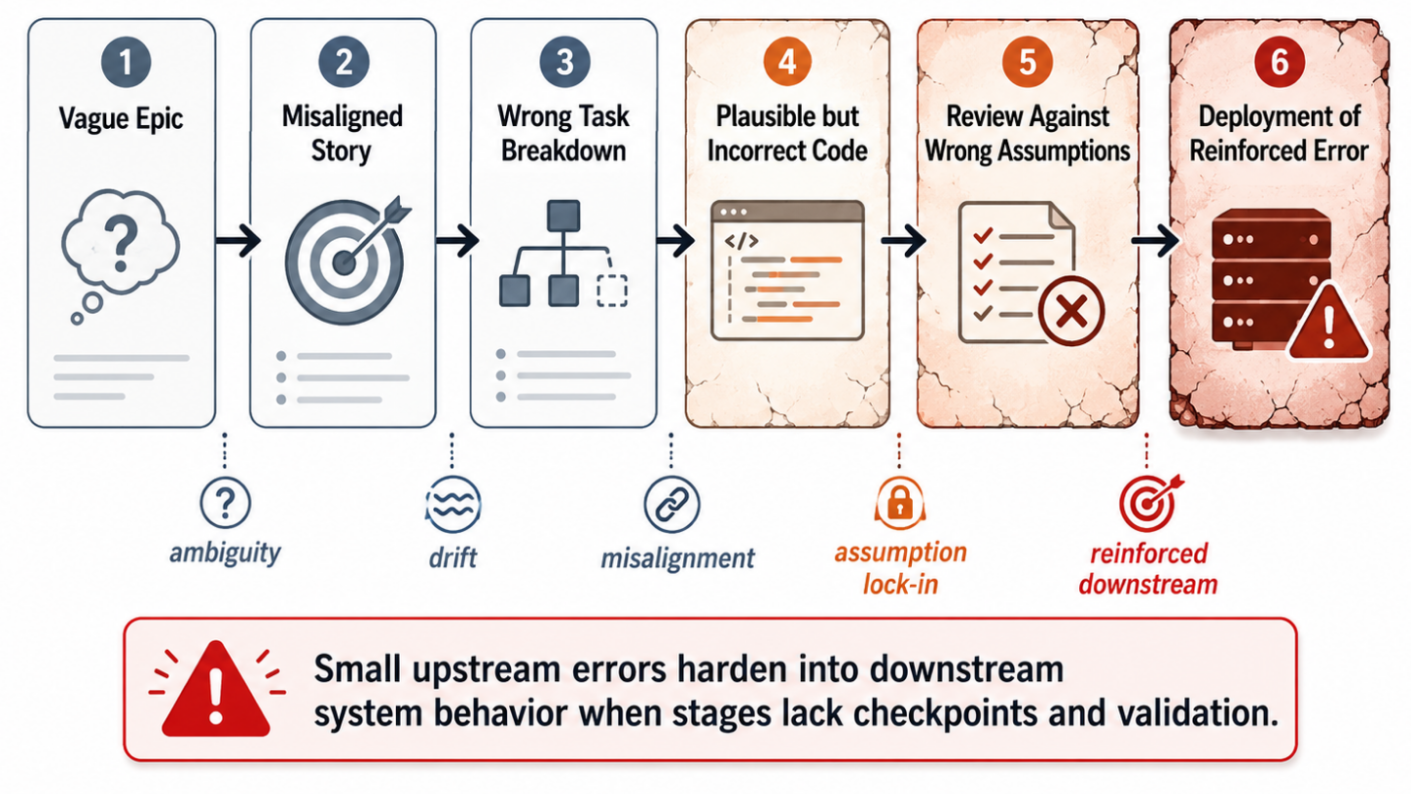
Chaining probabilistic systems without deterministic breaks is an architectural antipattern — not because it cannot be done, but because uncertainty compounds with no floor. If each stage is 90% reliable and you run seven steps in sequence, you get roughly 48% end-to-end reliability at best. In practice it is worse, because errors are not independent. A flawed assumption in the epic does not produce seven separate mistakes. It produces one correlated failure that every downstream stage inherits, deepens, and locks in.
There is also a subtler cost that is easy to miss. In a purely LLM-chained pipeline, the reasoning behind decisions disappears. Why was the epic scoped this way? Why did the architecture take this shape? Why was this tradeoff made? If that reasoning is buried across multiple generations of probabilistic context, it is never logged, reviewed, or preserved. Future engineers can audit the what but not the why. Post-incident reviews become guesswork. Refactoring becomes archaeology. The codebase resists change not because it is complex, but because it is opaque by construction.
What deterministic gates actually fix
They add reliability, and they create a paper trail. The pipeline should look like this:

Each gate should define the expected input, acceptable output, assumptions made, and checks that must pass before the next stage begins. Some gates can be fully automated:
- schema validation, test-coverage thresholds, static analysis, security scans
- CI/CD rules and traceability from requirement to code
Others require human judgment:
- product intent and architectural coherence
- risk acceptance and production readiness
The strongest, most deterministic gates belong before the most expensive and irreversible steps: code generation and deployment. When a gate fails, the right response is usually a feedback loop with enriched context, not a hard stop.
Where this matters most
The goal is not maximum autonomy. The goal is reliable software delivery. Autonomy without checkpoints does not eliminate the need for debugging — it only defers it, and makes it significantly more expensive when it finally arrives.