From AI Prototype to Production: The Control Loop Enterprise AI Needs
Production agentic AI is not chatbot → gateway → model. It is a managed control layer that validates inputs, measures context quality, evaluates outputs, monitors trends, and escalates when risk patterns change.
AI prototypes are often built for speed, and that is appropriate. The purpose of a prototype is to test whether an idea has value. But once a prototype moves toward production, the conversation about architecture changes.
The question is no longer only “Can this generate a useful response?” but rather “Can this be secured, evaluated, governed, monitored, and trusted inside an enterprise workflow?”
The common perception of agentic architecture
Early prototypes are often viewed as simple solutions, based on a common assumption:
“Once we connect a chatbot or agent to a model, we have an agentic AI solution.”
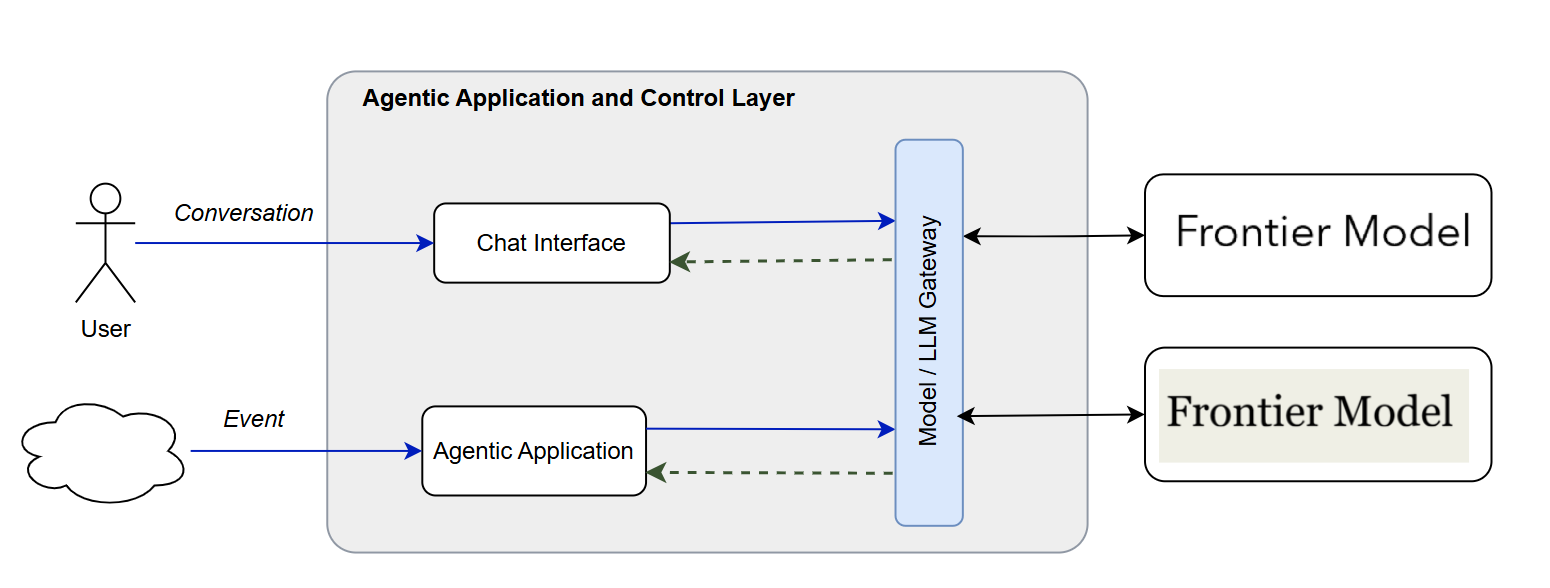
The next step often involves adding context engineering — retrieval and embeddings — around the model call. While this improves grounding, it remains insufficient for production. The system also requires controls to validate inputs, measure context quality, evaluate outputs, and detect drift over time.
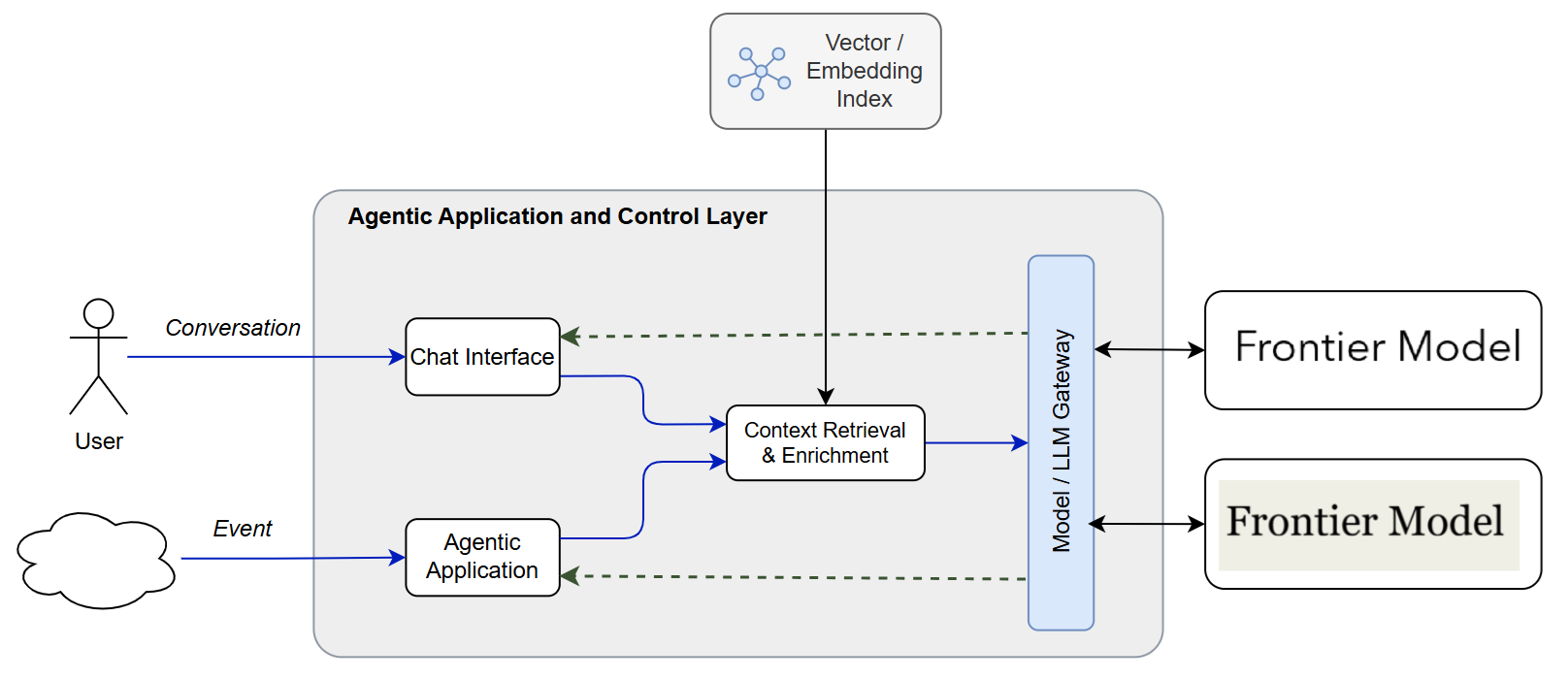
A robust enterprise solution needs guardrails, context-quality checks, output evaluation, metrics, gateway controls, and monitoring loops.
What changes in production
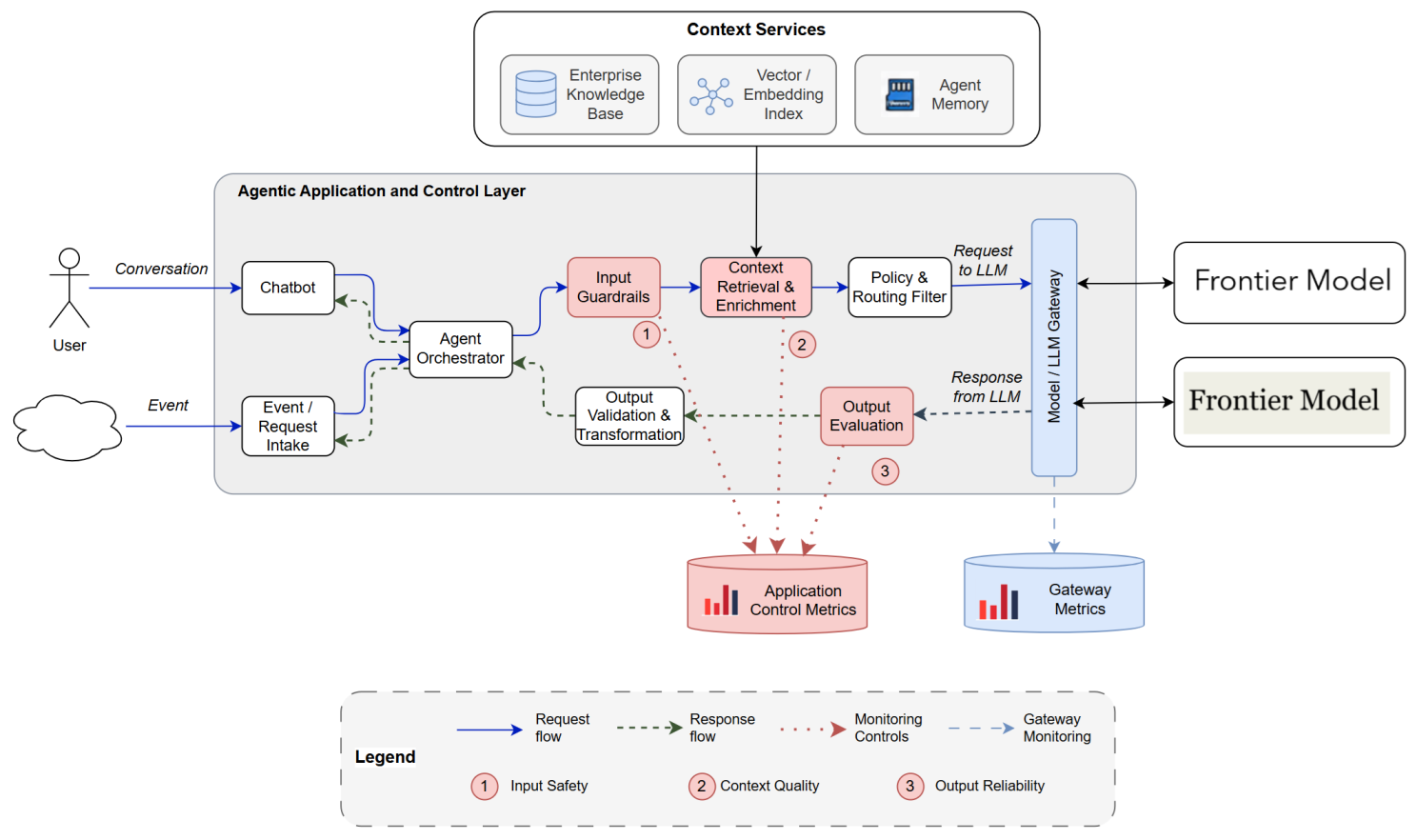
As the system moves toward production, the architecture must do more than send prompts to a model. It needs to control the full interaction lifecycle:
- Before a request reaches the model, check whether the input is safe, well-formed, and allowed.
- Before the model generates a response, ensure that retrieval and enrichment provide relevant and trustworthy context.
- Before the response is returned to a user, agent, or downstream system, evaluate it for structure, safety, accuracy, policy compliance, and action eligibility.
This creates a production control loop:
Architecture of an agentic solution
Users interact through a chat interface, while system events enter via an event or request intake path. Both workflows lead to an agent orchestrator that coordinates work before any request reaches the model. The request then moves through a controlled pipeline: input guardrails, context retrieval and enrichment, policy and routing, and finally the model or LLM gateway connecting to one or more frontier models.
The response does not return directly to the user or agent. Instead, it passes through the gateway, undergoes output evaluation, then validation and transformation, and finally returns to the agent orchestrator and the appropriate workflow.
The main takeaway
Runtime signals for the control loop
A useful operating principle, albeit clichéd, applies well here: what cannot be measured cannot be improved. In production AI systems, validation cannot stop at pass/fail checks. The system must also capture how often inputs are rejected, how often context is weak, how often outputs fail validation, and whether those patterns change over time. That requires runtime signals from three control points.
1. Input safety
Before a request reaches the model, validate whether it is safe, well-formed, and allowed. Typical signals: prompt-injection attempts, PII/PCI/PHI detection, malformed payloads, policy-blocked inputs, and schema failures. This answers: are users, upstream systems, or attackers sending risky inputs into the AI system?
2. Context quality
Before the model generates a response, measure whether retrieval and enrichment provided useful grounding. Typical signals: retrieval hit rate, stale context, irrelevant context, source freshness, and grounding coverage. This answers: did the system provide the model with relevant, current, and trustworthy context?
3. Output reliability
Before a response is returned, validate whether it is safe, structured, accurate, and usable. Typical signals: hallucination rate, malformed JSON, missing fields, citation failure, unsafe recommendations, and policy violations. This answers: is the model producing responses that can be trusted and used safely?
Gateway metrics — latency, cost, model usage, throttling, errors, and routing behavior — should be tracked separately, because they reflect operational health rather than application-level reasoning quality.
Drift and alerts
The value of these metrics lies in trend detection. A single validation failure may be acceptable, but spikes in prompt-injection attempts, stale retrieval results, malformed outputs, unsafe recommendations, or human rejections should prompt investigation. These issues can arise from user behavior, upstream data quality, prompt changes, model upgrades, retrieval changes, stale documents, or business-process changes.
Validate each interaction, measure rejections, monitor trends, and escalate when risk patterns change.
Final thought
Adding context engineering through retrieval, embeddings, and memory improves grounding, but context alone does not make a system enterprise-ready. Production systems need control loops. In enterprise AI, the hard part is rarely connecting to a model. The hard part is building the control layer that makes model-driven workflows safe, measurable, and operable.